
Late Night Fashion: The Subculture That Dresses After Dark
The clothes worn between midnight and 4am have their own logic and their own codes. A complete guide to late-night subculture fashion and what it means to dress for the dark hours.
Reader-supported: we may earn a commission from links in this article, at no cost to you. As an Amazon Associate we earn from qualifying purchases. How we make money.
The Hours When the Uniform Changes
There is a specific transformation that happens to a city between midnight and dawn. The people left on the street after 2am are not the same population that populated it at 7pm. The reasons people are out have changed. The purposes have changed. And the clothes — the clothes change too, following a logic that has almost nothing to do with daytime dress codes, office-casual conventions, or the aspirational posturing that defines how people dress when they think the important world is watching.
Late-night fashion — the aesthetic that governs what streetwear culture wears in the hours before and after last call, in the line for a club, at the diner afterward, in the transit home — has its own history, its own codes, and its own relationship to subcultural identity. It borrows from streetwear but extends it into a different emotional register. It is less about aspiration and more about belonging. Less about what you are building and more about who you are when the building stops for the night.
Understanding late-night fashion requires understanding the subcultures that created and maintain it: rave and club culture, hip-hop nightlife, after-hours art communities, the specific social infrastructure of cities that function past midnight.
The Foundation: Nightlife and Subculture Aesthetics
Nightlife fashion has a longer history than streetwear as a named phenomenon. The club cultures of 1970s New York and London — disco, early punk, the Factory scene around Warhol — created distinct aesthetics that were invisible to the mainstream and meaningful within the community. Studio 54's guest list understood that what you wore communicated which part of the culture you were actually part of.
The rave culture of the late 1980s and early 1990s represents a specific chapter that is still directly influencing late-night dress. British rave culture developed its look from the practical constraints of dancing for hours in warehouses: comfortable, non-restricting, easy to move in, able to absorb sweat, and able to signal membership in a community that was simultaneously underground and massive. Adidas tracksuits, smiley face graphics, neon accents, baggy trousers — the rave aesthetic was functional in the way that the workwear crossover is functional: designed around what the activity actually required.
The difference between rave's functional dressing and workwear's functional dressing is in the energy they channeled. Workwear dressing is about durability and labor. Rave dressing was about staying in motion, staying comfortable, and signaling belonging to something that the people who stayed home did not understand.
Club Culture's Visual Grammar
The visual grammar of club dressing varies significantly by scene and city, but some consistent elements appear across geographies and eras.
The oversized silhouette dominates late-night fashion in ways it does not always dominate daytime streetwear. Clubs and music venues are warm, physical spaces where body heat is real. Oversized fits breathe. They also create a certain kind of presence — the loose, unhurried look that communicates comfort rather than effort.
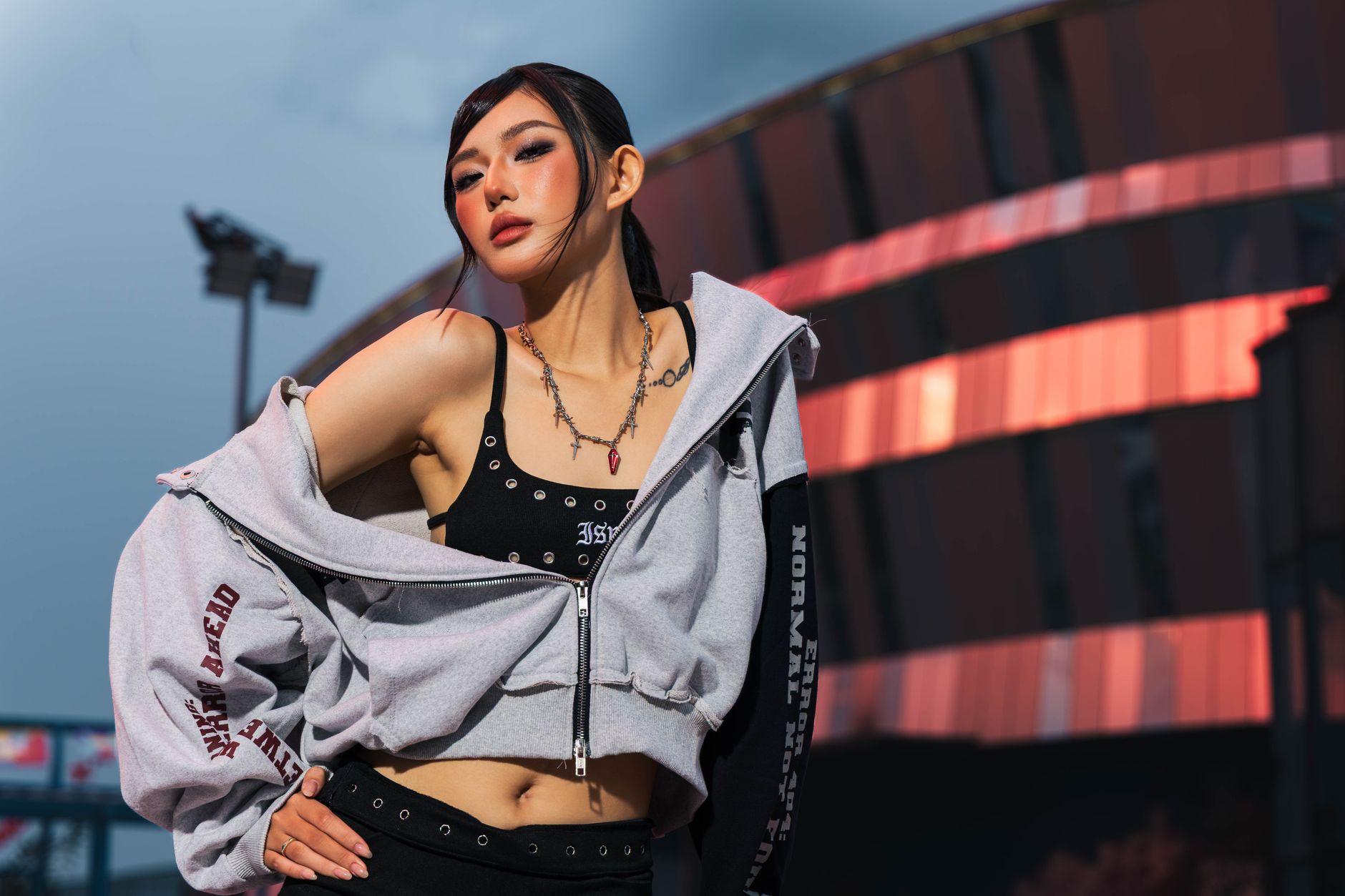
All-black or dark-palette dressing is a practical and aesthetic choice. Black does not show the accumulated marks of a long night. It creates visual coherence across any combination of pieces. It reads as serious without being formal. The late-night all-black look — black jeans or trousers, black top, dark jacket — is the outfit that has never not worked and never will.
Functional outerwear takes on a different meaning at night. The leather jacket, the MA-1 bomber, the military field jacket — these pieces that read as aesthetic choices in daytime have a different utility at night: protection between the club's warmth and the cold outside, something to leave at the coat check or carry, an outer layer that signals that you came from somewhere and are going somewhere.
The footwear problem is real for late-night dressing: you need something that can handle hours of movement on potentially rough floors (both literal and metaphorical) but also looks intentional. This is why chunky sneakers and simple leather footwear have long dominated club-adjacent fashion. The Adidas Samba's current mainstream moment is partly driven by its status as a genuine late-night shoe — narrow enough to feel dressy, comfortable enough to last hours.
Brands That Belong to the Night
Certain brands have developed such strong associations with nightlife culture that wearing them functions as subcultural signaling. This is not calculated brand positioning; it happens because the communities that formed around the brand's aesthetics overlapped with specific nightlife communities.
Raf Simons — The Belgian designer's work, particularly from the late 1990s and early 2000s, resonates so deeply with club and rave culture that pieces from that era are treated as relics. The graphic language of early Raf Simons — text, abstracted references to music and cinema, dark palette — communicates a specific relationship to post-rave European youth culture that never reads entirely legible to outsiders. That slight illegibility is part of the function.
Undercover — Jun Takahashi's brand has a deep relationship with music subcultures, particularly punk and industrial. Wearing Undercover at night is a way of signaling that you take music seriously as a cultural force, which reads as a very specific kind of cool in certain scenes.
Cav Empt — Toby Feltwell and SK8THING's brand, drawing on digital aesthetics, early internet visual culture, and cyberpunk references, reads as native to the specific generation that grew up online and went to raves. The graphics feel designed for bad lighting and phone cameras.
Represent, Corteiz, and the new UK wave — British brands emerging from urban culture that explicitly reference nightlife and the specific aesthetics of post-midnight London. Corteiz in particular has built a community that is inseparable from London street and nightlife culture — the drops, the runs, the community events all happen in ways that blur the line between brand activity and subcultural social life.

The 2AM Specific: What the Name Means
There is something specific about the 2am moment in nightlife culture. It is after midnight's novelty and before dawn's reckoning. The city is at its most itself — the people who came out to be seen have largely gone home, leaving behind the people who came out because this is actually where they want to be.
The fashion that works at 2am is not trying to impress in a conventional sense. It has already decided what it is and committed to that. The best-dressed people at 2am are not wearing the flashiest pieces; they are wearing the pieces that feel most like them, worn with the ease of someone who stopped thinking about their clothes two hours ago and is just being.
This is where the Wear2AM name draws its meaning — that specific hour and its specific energy. The late-night aesthetic connects to the brand's broader philosophy around clothes as authentic expression rather than performance.
The Crossover: How Late-Night Looks Travel
One of the interesting dynamics in late-night fashion is how pieces move between contexts. The club look that originated in Berlin warehouse culture becomes a daytime fashion reference. The rave tracksuit becomes streetwear. The after-party outfit gets restyled for a Tuesday afternoon.
This movement works in both directions: daytime streetwear is constantly absorbed into nightlife contexts, and nightlife's aesthetic experiments filter back into daytime wear. The mechanism is the people themselves — the same people dressing one way at 3pm are dressing a different way at 3am, and they bring references from each context into the other.
The Y2K revival's relationship to nightlife is a good example: many of the most distinctly Y2K pieces — the velour tracksuit, certain logomania references, the trucker hat — have their most natural contexts in nightlife. They were associated with celebrity nightlife in their original iteration, and the nostalgia revival has brought that association back.
City by City: How Late-Night Fashion Differs
Late-night fashion is not uniform across cities, and the differences are meaningful.
New York late-night fashion draws on hip-hop heritage, the legacy of downtown art scenes, and the general energy of a city where nightlife has to justify its existence in competition with everything else available. The look tends toward individual self-expression within a broadly streetwear-influenced vocabulary. Getting dressed for New York nightlife means showing that you live here and know what this is.
London late-night fashion has a harder edge that connects to grime, garage, UK drill, and the specific working-class energy of British urban culture. Technical outerwear over streetwear basics. The specific London look of north face gillet over a hoodie, which has moved from subcultural practical choice to genuine fashion reference.
Berlin late-night fashion is famous for its anti-fashion quality — the club scene's default is technical wear and black, with the point being that you are not performing for anyone, you are there for the music. The Berghain dress code story (technical, dark, functional) has become a global shorthand for a specific orientation toward nightlife.
Tokyo late-night fashion applies the same precision and scene-specificity that Japanese streetwear culture generally demonstrates, but concentrated in specific district subcultures — the Shimokitazawa indie music crowd, the Shibuya club scene — each with distinct aesthetics that reflect the music and social community involved.
The Practical Guide to Late-Night Dressing
Beyond the cultural analysis, the practical question: what actually works for late-night dressing?
Temperature management is the primary challenge. You will be cold outside and warm inside, potentially for a long stretch of hours. Layering is non-negotiable. The outer layer needs to be something you can comfortably hold or leave somewhere — not precious, not delicate, not difficult to manage. A classic bomber, a simple canvas jacket, an oversized denim piece.
Comfort for the long haul means reconsidering any piece that is uncomfortable to sit, stand, or move in for hours. The tight pair of jeans that looks perfect in a bathroom mirror becomes an adversary by hour three. Relaxed-fit trousers, comfortable but visually clean sneakers, nothing that requires constant adjustment.
The detail that reads in low light: specific pieces read better in clubs and bars than others. Bold graphic tees with high contrast. Strong silhouettes rather than intricate pattern work that disappears in dim light. Simple jewelry that catches light. The late-night wardrobe is not the right context for subtlety.
The all-black foundation remains the most reliable starting point because it solves the temperature-management and the visual coherence problems simultaneously. One color, multiple textures — matte cotton, subtle shine, denim, leather — creates an outfit that holds up across hours and contexts.
Late Night as Cultural Time
The deeper significance of late-night subculture is not really about clothes. It is about time — specifically, the reclamation of time from the structures that organize most of life. The late-night hours are, for people who participate in nightlife culture, a space that operates by different rules. The hierarchies of the daytime do not fully apply. The performance of social status takes different forms, often less formal and more immediate.
Fashion participates in this because clothing is always a participation in social reality. The clothes that work at night are the ones that communicate participation in the specific social reality of night culture — community over status, movement over stasis, presence over performance.
Dazed magazine has been covering the intersection of nightlife culture and fashion since the 1990s, and their archive is one of the best resources for understanding how the aesthetic has developed over decades. i-D magazine similarly has documented late-night subcultures extensively.
What makes late-night fashion interesting as a cultural category is that it resists the usual modes of fashion communication. There is no red carpet for nightlife, no official moment of cultural validation. The late-night look is validated only by the community that wears it and recognizes it. That makes it more authentic than almost anything else in the fashion system.
Shop Our Collection
Wear2AM was built for exactly these hours — the part of the day when you are most yourself and what you wear should match. Our collection is designed for people who are out when they want to be and dressed to prove it.
Shop this guide

adidas Essentials Men's Tracksuit
The piece traces late-night dress to rave-era Adidas tracksuits built for hours of movement.
BUY ON AMAZON →
adidas Samba OG
Called out as a genuine late-night shoe: narrow enough to feel dressy, comfortable for hours.
BUY ON AMAZON →
Alpha Industries MA-1 Bomber Jacket
The MA-1 is named as the functional night outerwear you can hold or check.
BUY ON AMAZON →RELATED READS

Puma Speedcat Celebrities: Why the 90s F1 Racing Shoe Is 2026’s It‑Sneaker
Dua Lipa, Gracie Abrams, Emily Ratajkowski, and Rihanna have turned the Puma Speedcat OG into a cultural must‑have.
Best Custom Graphic Tee Methods: DTF vs Screen vs HTV 2026
DTF, screen printing, HTV, or sublimation — which method actually works best for custom graphic tees in 2026? We break down costs, gear, and results.

Why Skatewear Still Runs Modern Streetwear in 2026
Skateboarding built streetwear. In 2026, skate culture still dictates silhouettes, brands, and attitude in ways most people never notice. Here's how skatewear still shapes what you wear.