
Skateboarding and Streetwear: The Original Relationship
Supreme, Palace, Vans and the whole infrastructure of modern streetwear trace back to skateboarding. The complete history of how skate culture built the clothes the world wears.
Reader-supported: we may earn a commission from links in this article, at no cost to you. As an Amazon Associate we earn from qualifying purchases. How we make money.
Every Brand You Love Started Here
The genealogy of contemporary streetwear, traced backward, runs through skateboarding with a consistency that cannot be dismissed as coincidence. Supreme was a skate shop before it was a cultural institution. Palace grew out of a London skate crew before it was a brand. Vans was making shoes for skaters fifteen years before any fashion person noticed. Stüssy's aesthetic was shaped by surf and skate culture before it went global. The fonts, the graphics, the attitude, the limited-distribution model, the community-over-commerce mythology — all of it developed in skateboarding before anyone called it streetwear.
This is not a niche or debatable historical point. It is the foundational fact of how the industry works. To understand streetwear you have to understand skateboarding, and to understand skateboarding's fashion legacy you have to understand why a subculture built around bruises and public property developed one of the most influential aesthetic sensibilities in modern fashion history.
The Early Infrastructure: Skateboarding's Anti-Fashion Fashion
Skateboarding's relationship to clothes was originally purely functional. You needed shoes that gripped grip tape and survived being dragged across concrete. You needed pants loose enough to move in but not so baggy they caught air and slowed you down. You needed a shirt that could absorb sweat and take the friction of pavement falls.
The companies that first solved these problems — Vans in 1966 with the Era and Authentique, Vision Skateboards with their logo tees in the mid-1980s, Powell Peralta with the Bones Brigade graphics — were creating functional product. The graphic on a Powell Peralta deck was not originally a fashion statement; it was team branding and a visual identity that allowed skaters to recognize each other's affiliations. That graphic language spilled onto clothing because the same community that rode the decks wore the associated gear.
What made skate graphics different from standard sportswear branding was their irreverence. Skateboarding from its earliest incarnation was hostile to authority, suspicious of mainstream institutions, and interested in subverting rather than celebrating dominant culture. The graphics reflected that: skulls, distorted figures, imagery pulled from underground art and horror and surrealism. This aesthetic DNA, developed in the 1980s California skate scene, is what gave the eventual streetwear brands that emerged from it a visual edge that pure fashion brands struggled to replicate.
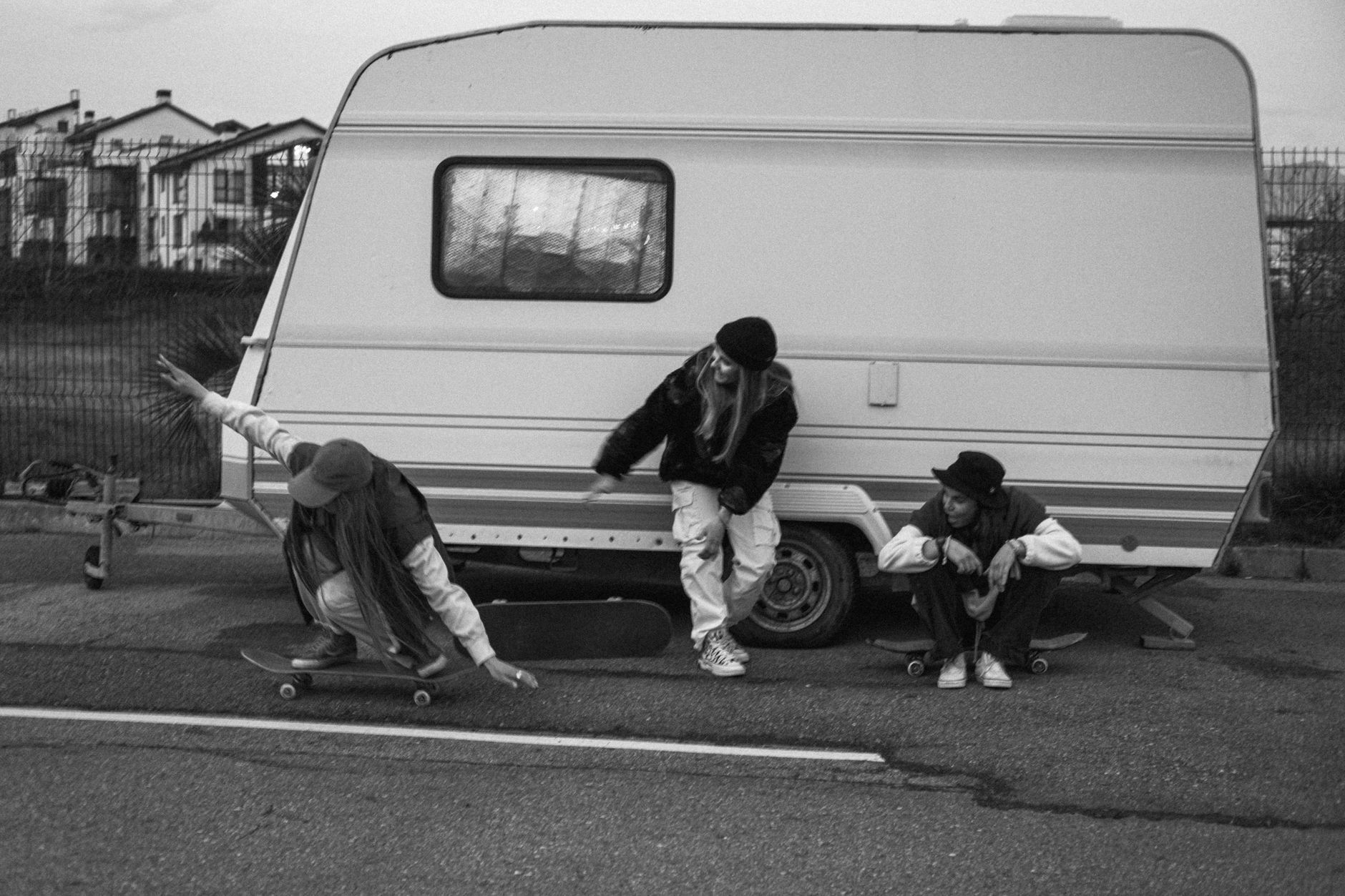
Vans: The Shoe That Outlived Every Era
Vans was founded in 1966 in Anaheim, California by Paul Van Doren and partners, initially making shoes on-demand in a factory-retail combination that was unusual for the time. The original Vans styles — the #44 (now known as the Authentic), the Era (designed with the input of professional skaters Tony Alva and Stacy Peralta) — were not produced with fashion in mind. They were rubber-soled canvas shoes designed to grip and last.
The Era's waffle sole was an accident of early manufacturing that turned out to be excellent for skateboarding: the pattern created friction against grip tape without wearing down quickly. Skaters noticed this and the shoes became ubiquitous in California skate culture through the 1970s. By the 1980s, Vans was the default skate shoe, worn by the Bones Brigade and documented in every skate video of the era.
The 1982 film "Fast Times at Ridgemont High" introduced Vans to a nationwide audience through Sean Penn's character, creating the first mass-culture moment for the brand. But Vans' cultural ascent is not simply a movie story — it is a story about a product that worked, was adopted by a community with cultural influence, and spread through that influence rather than through conventional marketing.
The Sk8-Hi, launched in 1978, added the iconic side stripe and the high-ankle support that made it functional for both skating and the kind of casual wear it now dominates. The Old Skool's status as one of the best-selling casual sneakers of all time traces directly to this functional-then-fashionable trajectory.
Vans has maintained its skate credibility through continued team sponsorships and the Vans Skate Pro events while also being commercially ubiquitous at a scale that would typically destroy subcultural credibility. The reason it has navigated this is structural: Vans actually makes products used by actual skaters, and the company has maintained those product lines and relationships rather than abandoning them as the fashion business grew.
Supreme: The Shop That Became the Template
James Jebbia opened Supreme on Lafayette Street in Manhattan in April 1994. The story of the interior layout has been told many times but bears repeating because it explains the entire business model: Jebbia positioned the racks of clothing around the perimeter of the space rather than filling the center of the floor, because he knew skaters would come in to hang out and they needed room to skate. The shop was designed for the community before it was designed for sales.
This community orientation shaped everything Supreme became. The decision to produce in limited quantities was not originally a calculated scarcity play — it was a small brand making what it could sell in one shop to one community. The consequence was that Supreme product was scarce by default. The cultural reading of that scarcity — as exclusivity, as desirability — came from the community that wore it, not from a marketing strategy.
The box logo tee, now the most recognizable and financially valued item in Supreme's catalog, began as a functional shop tee. The Futura 2000 logo in red and white was clean, direct, and associated with a specific community. Wearing it meant you were part of something. That meaning was created by the community around the shop, not by advertising.
Supreme's evolution from skate shop to global brand — the expansion to Los Angeles, London, Paris, Tokyo; the collaborations with Louis Vuitton and The North Face; the Carlyle Group acquisition and eventual VF Corporation purchase — has been documented exhaustively. What matters for understanding streetwear's relationship to skateboarding is that the entire model Supreme established — limited quantities, community-first distribution, meaningful collaborations, single-item weekly drops — emerged directly from a skate shop's practical constraints and community values.
Palace: London Doing It Differently
Palace Skateboards was founded in London in 2009 by Lev Tanju, emerging from the Lambeth-based Waverly skate crew. The brand's origin in an actual riding crew gave it something that brands trying to manufacture skate credibility cannot replicate: it was actually made by skaters who skated together, documented their sessions, and built a community before they built a business.
Palace's aesthetic is a distinct variation on the skate-streetwear template — less New York hip-hop influence, more British working-class humor and irreverence, more explicit engagement with football culture and rave history. The Tri-Ferg logo (Palace's distinctive three-pointed design) has the same recognition-mark function as Supreme's box logo but reads differently: more geometric, more aligned with British design sensibilities, more comfortable with its own weirdness.
The brand's collaborations have been consistently interesting precisely because they tend toward cultural partners that feel slightly unexpected. Palace x Adidas has been an ongoing productive relationship. Palace x Moschino. Palace x Calvin Klein. Palace x Harrods, which was either brilliant commentary or genuine cultural confusion, possibly both. The brand has a sense of humor about itself that prevents it from becoming too reverent about its own mythology.
For a deeper look at Palace specifically, the brand spotlight on Palace Skateboards covers the full story in more detail.
The Graphic Language: Where Skate Art Became Streetwear's Visual Vocabulary
The connection between skateboarding and streetwear is not just commercial and structural — it is visual. Skateboarding developed a distinct graphic vocabulary in the 1980s that has never stopped influencing how streetwear presents itself.
The pioneers: Jim Phillips created graphics for Santa Cruz Skateboards (including the original "Screaming Hand") that established the horror-influenced, high-contrast illustration style that became synonymous with skate graphics. Vernon Courtland Johnson designed for Powell Peralta, creating the Ripper and other iconic deck graphics with a different, more precise linework aesthetic. Mark Gonzales, skating for Vision and later founding Blind Skateboards, brought a raw, expressionist drawing style that influenced both skate art and downtown New York art-world aesthetics.
These visual influences moved into streetwear graphics in the same way the skate community's values did — through the people themselves, who were simultaneously skaters, artists, musicians, and eventually brand founders. The aesthetic was not borrowed or licensed; it was carried by the same individuals who built the culture.
Graphic tee culture in its current form is unimaginable without this foundational visual language. The distressed prints, the bold one-color designs, the irreverent imagery, the reference-dense graphics — all of it traces back to the Powell Peralta catalog and the independents that followed.
Skateboarding's Gift to Sneaker Culture
The relationship between skateboarding and sneakers is one of the most consequential in the history of footwear. Vans was not the only brand shaped by skate adoption — the Nike Dunk SB story, which began with the Nike SB program in 2002, fundamentally transformed how limited sneaker releases work and what the sneaker collector community cares about. The full Dunk history demonstrates how a decade of skate-specific distribution built a model that the entire industry later adopted.
Emerica, éS Footwear, Etnies, Globe, DVS — the dedicated skate shoe brands of the 1990s and early 2000s built technical innovations (impact cushioning, specific materials for grip tape resistance, reinforced ollie areas) that mainstream sneaker brands later incorporated. The technical learning from skateboarding improved general sneaker design.
The brand relationships worked both ways: skateboarding gave credibility to sneaker brands that engaged genuinely, and sneaker brands provided resources that allowed skateboarding to professionalize and reach broader audiences. The Nike SB program, for all the community suspicion it initially generated, produced one of the best eras in skate shoe history.
The Community Model and How It Changed Commerce
Perhaps skateboarding's most lasting contribution to streetwear is the community-first commerce model that the most successful brands still use. The skate shop network — independent retail, community-embedded, with close relationships to local skate teams and scenes — was the original infrastructure for limited streetwear distribution. The concept of a shop being a cultural institution rather than just a retail space, of knowing the staff and being recognized as a regular, came directly from skate shop culture.
This model has been threatened by the scale of e-commerce and algorithmic resale markets. The ability to order anything from anywhere has changed what physical retail has to offer, and the most successful streetwear shops have responded by doubling down on the community elements that cannot be replicated online: events, local team support, exclusive product relationships.

The drop model — limited quantities, specific release times, queuing either physically or digitally — emerged from skate shop distribution before Supreme made it explicit. The practice of going to a specific shop on a specific day and potentially not getting what you went for if you were not early enough was not a marketing invention; it was a consequence of small production runs and specific retail relationships.
The Current State of Skate's Influence
Skateboarding's influence on streetwear in 2026 is simultaneously total and invisible — it is so embedded in how the industry works that it no longer needs to be explicitly acknowledged. The brands that openly reference skate heritage (Palace, Supreme, Polar Skate Co., Quartersnacks, the continuing skate team structures at major brands) represent the visible end of an influence that runs through the entire industry.
The current skate scene itself is interesting: the professional circuit, bolstered by skateboarding's Olympic inclusion since Tokyo 2020, has brought formal competition structures to a culture that historically defined itself against formal competition. The response within street skating — the community that cares more about creative expression and difficulty than point scores — has been to reassert its own values more explicitly. Small, scene-specific brands, local team sponsorships, video parts that circulate through community channels rather than broadcast media.
Hypebeast's skateboarding coverage documents the active brands and scene regularly. Quartersnacks is the best resource for actual skate culture perspective on what matters in the scene.
The relationship between skateboarding and streetwear is not going to resolve neatly into a single direction. It will continue to be complicated, productive, occasionally exploitative, and culturally generative. That is more or less what has been true for the last forty years, and there is no reason to expect it to change.
What This Means for How You Buy and Wear Things
If you understand that the brands you care about in streetwear have their roots in skateboarding's community values and anti-commercial ethos, it changes how you relate to them. The limited releases are not cynical manipulation — they originate in the practical reality of small producers serving tight communities. The collaborations, when they work, are not purely commercial exercises — they originate in personal relationships between people who actually know and respect each other's work.
This does not mean the industry is pure or that exploitative practices do not exist within it. They absolutely do, and they increase as the money gets bigger. But the culture has a center of gravity that keeps pulling back toward the original values: community, craft, irreverence, independence. That gravity comes from skateboarding, and it is still there.
Shop Our Collection
The Wear2AM line takes skate culture's straightforward, quality-first approach seriously. No excess, no filler — gear built to wear and keep wearing.
Shop this guide

Vans Authentic
The original #44 canvas, named as the on-demand skate shoe that started Vans.
BUY ON AMAZON →
Vans Old Skool
Called out as the casual sneaker whose sales trace to skate function, then fashion.
BUY ON AMAZON →
Vans Sk8-Hi
The 1978 high-top the article credits with side-stripe support that became casual wear.
BUY ON AMAZON →RELATED READS

Puma Speedcat Celebrities: Why the 90s F1 Racing Shoe Is 2026’s It‑Sneaker
Dua Lipa, Gracie Abrams, Emily Ratajkowski, and Rihanna have turned the Puma Speedcat OG into a cultural must‑have.
Best Custom Graphic Tee Methods: DTF vs Screen vs HTV 2026
DTF, screen printing, HTV, or sublimation — which method actually works best for custom graphic tees in 2026? We break down costs, gear, and results.

Why Skatewear Still Runs Modern Streetwear in 2026
Skateboarding built streetwear. In 2026, skate culture still dictates silhouettes, brands, and attitude in ways most people never notice. Here's how skatewear still shapes what you wear.